Interview Prep
8 Coinbase OA Reports 2026: Real SWE Questions & AI Coding
Pian Yang · Marketing Specialist ·

What does the Coinbase online assessment look like in 2026? Recent Software Engineer candidates have reported different coding formats, from multi-level programming tasks to Flappy Bird-style simulations with built-in AI tools. The questions also vary in structure, making it difficult to prepare for Coinbase OA using a single assessment format.
This article analyzes eight Coinbase SWE coding experiences shared on Screna between May and July 2026. It covers reported assessment formats, real coding questions, common challenges, and preparation strategies. The findings are based on candidate-reported experiences rather than official Coinbase assessment guidelines. Some reports do not fully confirm the formal OA format, so individual experiences should not be treated as universal hiring requirements.
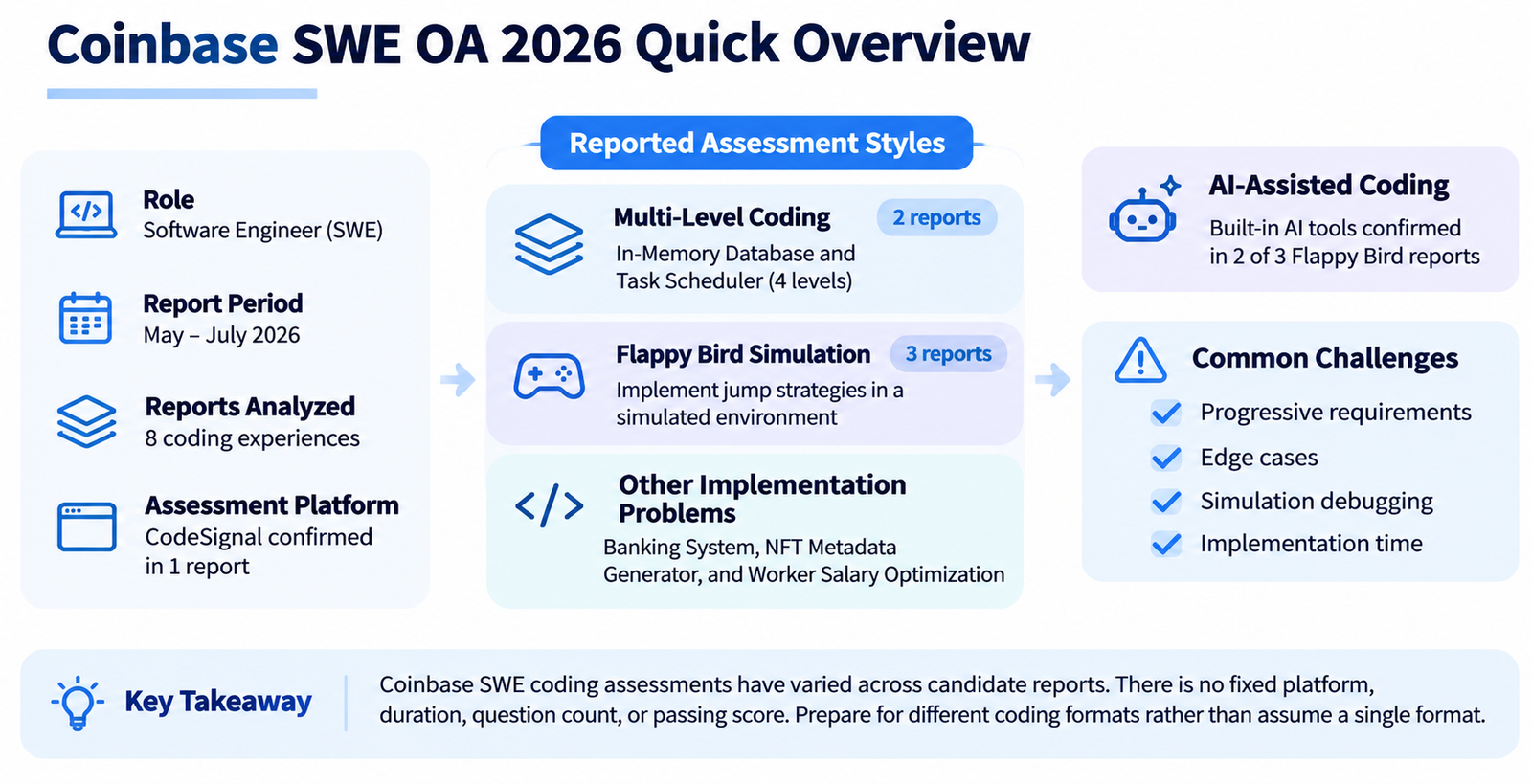
Coinbase SWE OA 2026 Quick Overview
The eight Coinbase SWE coding reports reveal several assessment styles, including four-level programming tasks, Flappy Bird simulations, and standalone implementation problems. Two reports described multi-level coding, while three involved Flappy Bird-style questions. Built-in AI assistance was explicitly mentioned in two of the three Flappy Bird experiences.
| Category | What Candidates Reported |
|---|---|
| Role | Software Engineer |
| Report Period | May–July 2026 |
| Reports Analyzed | 8 coding experiences |
| Assessment Platform | CodeSignal explicitly confirmed in one report |
| Multi-Level Coding | In-Memory Database and Task Scheduler, both with four levels |
| Simulation Questions | 3 Flappy Bird-style coding experiences |
| AI-Assisted Coding | Built-in AI tools confirmed in 2 of 3 Flappy Bird reports |
| Other Coding Questions | Banking System, NFT Metadata Generator, and Worker Salary Optimization |
| Common Challenges | Progressive requirements, edge cases, simulation debugging, and implementation time |
Coinbase Online Assessment Format
Coinbase CodeSignal Assessment and Multi-Level Coding Format
Multi-level coding appeared in two Coinbase SWE reports from 2026. Instead of solving several unrelated algorithm questions, candidates worked through a single programming task that introduced new requirements at successive levels. Earlier implementation decisions affected how easily later functionality could be added.
The Coinbase CodeSignal Task Scheduler OA explicitly identified CodeSignal as the assessment platform. Its four levels began with basic scheduling operations and gradually introduced more complex functionality. Partial credit was reported by level, although the complete scoring calculation was not provided. A similar progressive structure appeared in the Coinbase In-Memory Database OA, which expanded from basic key-value operations to prefix scanning, expiration rules, and backup/restore functionality. Both tasks required candidates to extend earlier implementations rather than start over at each level. However, only the Task Scheduler report explicitly identified CodeSignal, and the available evidence does not establish a universal Coinbase OA platform or four-level format.
Coinbase Flappy Bird and AI-Assisted Coding Assessment Format
Flappy Bird-style coding appeared in three Coinbase SWE reports. These tasks required candidates to implement functions or agents that controlled movement through a simulated environment. Unlike conventional standalone algorithm questions, the solutions had to make repeated decisions based on game state, movement behavior, and boundary conditions.
The Coinbase Flappy Bird Dog & Coins assessment involved designing a jump strategy while managing ceiling and ground boundaries and limited coin resources. The interface provided a built-in AI assistant for generating code and an autopilot mode for visualizing the strategy. The Coinbase Flappy Bird Jump Boundary assessment also featured a visual simulation environment and built-in AI assistance, with the task focused on jump behavior near pipe gaps. A third Flappy Bird experience involved frame-by-frame decisions and forward simulation, but did not explicitly mention AI assistance. These accounts establish Flappy Bird-style simulation as a reported Coinbase coding format, while built-in AI tools are directly confirmed in only two of the three experiences.
Real Coinbase SWE Coding Questions and OA Reports
The following questions come from eight Coinbase SWE coding experiences reported between May and July 2026. While the reports are categorized as online assessments on Screna, some accounts do not provide enough detail to independently confirm the complete assessment format.
Coinbase Multi-Level Coding Questions: In-Memory Database and Task Scheduler
Two Coinbase SWE reports described multi-level coding problems involving an In-Memory Database and a Task Scheduler. Both followed a four-level structure that required candidates to extend an existing implementation as new requirements were introduced, rather than solve four independent algorithm questions. The In-Memory Database task covered key-value operations, prefix queries, data expiration, and backup/restore functionality. The Task Scheduler focused on task management, prioritization, user assignment, and status tracking. Both became more challenging as requirements expanded, particularly when earlier data-structure decisions affected later functionality. Although the tasks shared a progressive format, they tested different implementation skills and should not be treated as identical questions.
Coinbase Flappy Bird Coding Questions and Variations
Three Coinbase SWE reports involved Flappy Bird-style simulation problems that required candidates to implement jump strategies based on game state, obstacles, and movement behavior. The Dog & Coins variation introduced limited coin resources, requiring the strategy to account for both collision avoidance and resource consumption. The Jump Boundary Function task focused on jump behavior and boundary conditions near pipe gaps, with a visual map available for testing. In the Coinbase Flappy Bird Agent coding experience, the task involved making frame-by-frame jump decisions based on the character's position and surrounding environment. Simple fixed-threshold strategies were not sufficient for every situation. These problems shared a simulation-based approach but differed in their rules and implementation requirements, making them related variations rather than repeated instances of the same question.
Coinbase Banking System and NFT Metadata Generator Questions
The Coinbase Banking System coding problem involved processing banking account and transfer data. The task required ranking users by their total outgoing transfer amounts while handling tie-breaking rules, with the main focus on data aggregation, sorting, and implementation trade-offs. The Coinbase NFT Metadata Generator problem required generating unique NFT trait combinations from a given configuration while maintaining deterministic output and meeting scale constraints. The two tasks emphasized different skills: data processing in the banking problem and efficient combination generation in the NFT task. Although both experiences are categorized as OA reports on Screna, their original descriptions do not independently establish the complete formal assessment format.
Other Coinbase Coding Questions: Worker Salary Optimization
The Coinbase Worker Salary Optimization coding experience involved a problem related to worker salary optimization. The candidate found the underlying logic manageable after identifying the problem's pattern but reported that implementing the solution in Java took longer than expected. Since the original experience did not provide a complete problem statement or detailed constraints, the exact optimization objective and required algorithm cannot be reliably determined.
Common Coinbase OA Coding and AI-Assisted Assessment Challenges
Multi-Level Coding Challenges: Progressive Requirements and Edge Cases
Progressive requirements created difficulties in both the In-Memory Database and Task Scheduler assessments. A solution that worked for the initial operations could become difficult to extend as later levels introduced new functionality. TTL handling was a major challenge in the database task, particularly expiration boundaries and backup/restore behavior. The scheduler presented different difficulties, as user assignment, quotas, and overdue tracking exposed limitations in earlier data-structure decisions. Both experiences highlight the importance of designing extensible solutions while preserving existing functionality. The Task Scheduler report mentioned partial credit, but it did not establish a universal Coinbase CodeSignal scoring formula.
Coinbase Flappy Bird Challenges: Simulation Debugging and AI Tools
Simulation-based questions introduced challenges that were not always apparent from individual test results. In the Dog & Coins assessment, the initial strategy avoided some collisions but consumed coins too quickly, while the Jump Boundary Function task involved difficulties near pipe gaps. Visual simulation tools helped candidates identify problems that were harder to diagnose through test results alone. The Flappy Bird Agent experience also showed why simple position thresholds could fail and why forward simulation and safety margins might be more effective. Built-in AI assistance did not eliminate the need for debugging, as candidates still had to verify their strategies and handle edge cases. The Jump Boundary Function candidate passed 16 of 20 tests and advanced, but that individual result does not establish a Coinbase-wide passing threshold.
How to Prepare for Coinbase OA 2026
The following preparation strategies are based on coding patterns and challenges described in eight Coinbase SWE coding experiences. They reflect previously reported assessments and do not guarantee that future candidates will encounter the same questions or formats.
Practice Coinbase Multi-Level Coding Problems
Multi-level coding is a useful preparation area because the reported In-Memory Database and Task Scheduler assessments both required candidates to extend an existing implementation through successive stages. A practical exercise is to build a basic key-value store and gradually add prefix scanning, TTL handling, and backup/restore functionality. Task scheduling exercises can follow a similar progression, starting with basic operations before introducing priorities, user assignments, quotas, and completion tracking. Data-structure design deserves attention before implementation begins, as early decisions can complicate later requirements. Testing existing operations after every extension can also help identify regressions.
Prepare for Coinbase Flappy Bird Simulation and AI-Assisted Coding
Flappy Bird-style preparation should focus on movement decisions over time rather than isolated jump conditions. Candidates can practice implementing strategies that account for character position, nearby obstacles, movement behavior, and screen boundaries. Testing across multiple frames is particularly relevant because the reported problems involved collision boundaries, pipe gaps, and resource consumption. When a visual simulator is available, observing the strategy in action can help identify failures that are difficult to understand from test results alone. For AI-assisted coding, generated code should still be tested against the task's actual requirements. The reported experiences show that built-in AI tools may help with implementation but do not necessarily resolve edge cases or strategy errors.
Review Coinbase Interview Questions and Practice with Screna AI Mock
The Coinbase interview questions and experiences collection provides additional context for understanding reported coding tasks and differences between assessment formats. Reviewing these experiences can help candidates identify relevant skills and prepare for different types of technical questions. For broader interview preparation, Screna AI Mock offers role- and job-description-based conversational practice. Candidates can use it to explain technical decisions, discuss edge cases, and practice communicating their approach to unfamiliar engineering problems. Screna AI Mock does not replicate a CodeSignal assessment or provide a Flappy Bird coding environment, so hands-on coding practice remains essential. Combining real interview experiences with targeted coding exercises and role-specific mock interviews can support a more comprehensive Coinbase SWE interview preparation plan.