Interview Prep
8 Stripe Coding Assessment Reports 2026: KYC, CSV & More
Pian Yang · Marketing Specialist ·

Stripe coding assessments cover a range of business scenarios, with different requirements across reported tasks. For candidates preparing for the Stripe online assessment, familiarity with common algorithms may not be enough. They also need to understand how to implement complete functionality based on detailed specifications.
This article examines eight Stripe Software Engineer reports from Screna's 2026 interview database. All eight were tagged as OA, but only two explicitly described online assessments. The remaining reports covered coding rounds or interviews. Drawing on these experiences, this article explores the coding questions and assessment patterns reported by Stripe candidates.
Stripe OA Quick Overview
| Category | Key Findings From 8 Candidate Reports |
|---|---|
| Assessment Format | Single multi-part problems, connected coding tasks, and AI-assisted coding |
| Time Limits | A 60-minute OA with a three-part problem and a separate AI-assisted interview with approximately 30 minutes of actual coding |
| Reported Coding Questions | KYC verification (2 variations), CSV payment reports, datacenter command processing, decoder pipelines, and string parsing |
| Skills Tested | Business logic implementation, data parsing, input validation, state management, and multi-part functionality |
| Common Challenges | Combining validation rules, meeting strict output requirements, handling edge cases, and managing dependencies between stages |
| Preparation Focus | Business-oriented coding tasks, precise parsing and formatting, edge-case testing, and time management for multi-part problems |
| Platform and AI Usage | Most reports did not specify a platform; one SWE coding interview explicitly allowed AI assistance and required candidates to explain generated code |
What to Expect in the Stripe Online Assessment
Coding Format, Time Limits, and Multi-Part Questions
Question formats included a single problem divided into three parts, a sequential string-parsing OA, and two connected decoding problems. Other reported tasks involved implementing business rules or processing structured data. One rule-parsing interview also used an AI-assisted format.
Two reports provided specific timing details. A Stripe SWE OA report on Screna described a 60-minute assessment with one coding problem divided into three parts. An AI-assisted coding experience reported approximately 30 minutes of actual coding time.
Reported Variations in Stripe Coding Assessments
The eight candidate reports are grouped below by their primary focus. Multi-part structure can also appear in other categories, so the counts describe the reports' main topics rather than mutually exclusive question formats.
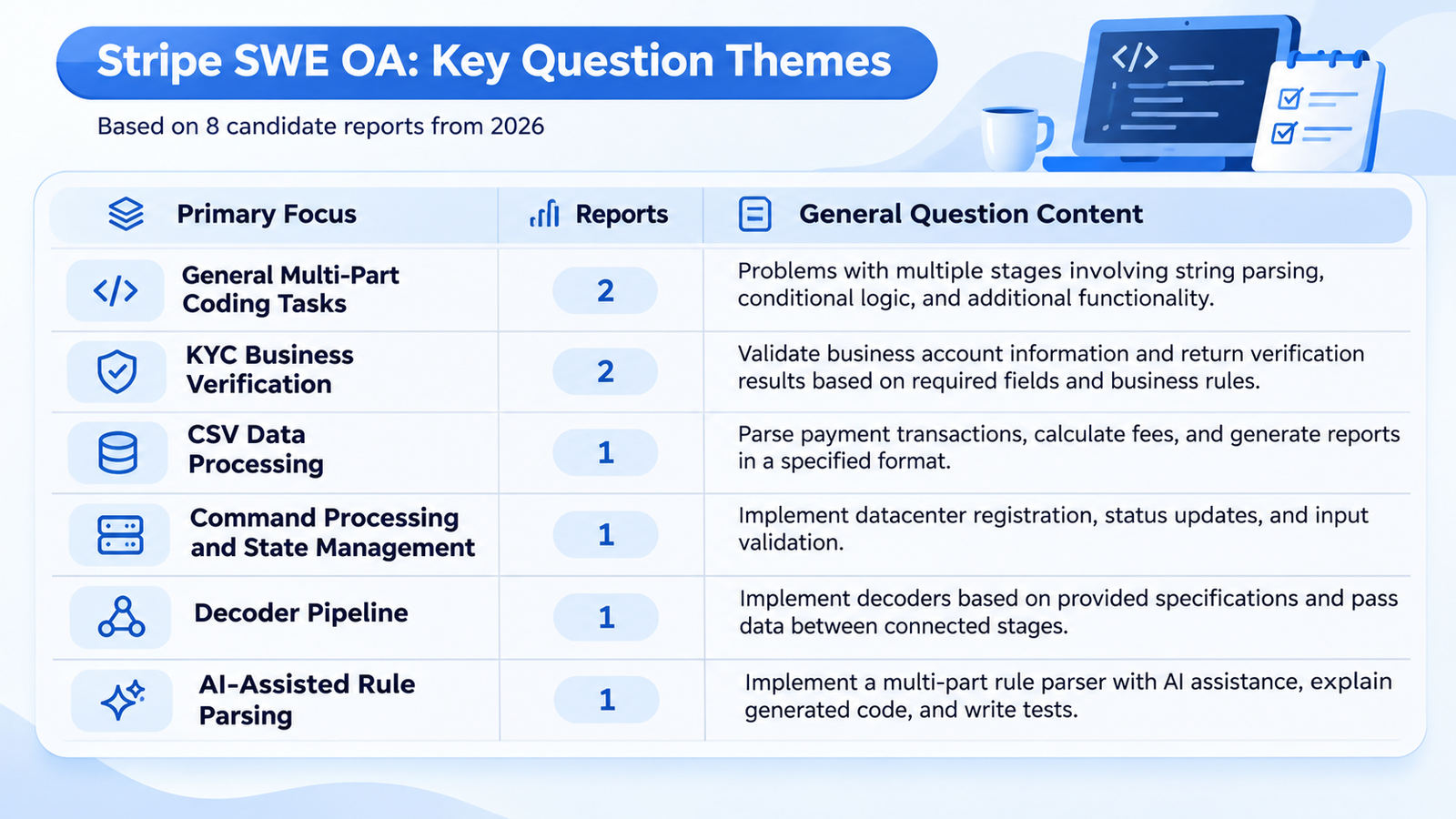
Real Stripe OA Coding Questions From Candidate Reports
KYC and Business Verification
KYC verification appeared in two related Stripe SWE coding reports. Both involved processing business account records, checking required fields, and comparing statement descriptors against a blocklist. The function needed to return VERIFIED or NOT_VERIFIED based on whether each record satisfied the specified conditions.
The more detailed KYC variation reported on Screna required all six fields to be present and non-empty, with a statement descriptor between 5 and 31 characters. It also included a word-overlap rule: at least 50% of the words in either the business name or full business name had to appear in the descriptor. The candidate initially calculated the overlap across both names together, which caused incorrect results for certain inputs.
The related KYC verification problem included field-presence checks, descriptor length validation, and case-insensitive blocklist matching. However, it did not report the 50% word-overlap rule or specify the same numerical length boundaries.
The two problems shared a business verification foundation but differed in their validation requirements. Both required candidates to combine several conditions while preserving the exact verification behavior described in the task.
CSV Parsing and Payment Reports
CSV processing was another reported Stripe coding task. A Stripe payment reporting experience involved reading transaction records, grouping payments by status, calculating fee-related totals, and generating a formatted report.
The main calculations were relatively straightforward, but the input contained several complications. Quoted fields could include commas, empty values required careful treatment, and some rows contained unexpected column counts or mixed line endings. The candidate completed the basic logic quickly but spent considerably more time debugging the output.
The report also required byte-exact formatting. Headers, column order, alignment, decimal precision, and the trailing newline all had to match the expected result. Even a minor spacing or newline difference could cause an otherwise correct report to fail.
Datacenter Routing and Command Processing
A Stripe datacenter routing problem asked the candidate to build a small command-processing system for managing datacenter records.
The implementation supported two operations: REGISTER and SET_HEALTHY. Registration required valid latitude and longitude values, positive capacity, and a unique datacenter name. The health-status command needed to update an existing record, with each operation returning either OK or ERROR.
Several small requirements made the implementation more demanding. A datacenter with zero capacity had to be rejected, not just one with negative capacity. Newly registered datacenters also needed to default to a healthy state, while commands targeting nonexistent datacenters had to fail.
The problem combined input validation with state management. A suitable implementation needed to maintain datacenter records consistently as commands were processed.
Decoder Pipelines and Multi-Part Problems
A Stripe decoder implementation experience involved two connected coding problems, including a decoder that had to follow a supplied specification. The decoding task involved dependent stages, where the output of one component fed into the next. The candidate described understanding the specification and coordinating these stages under time pressure as the main challenges.
What Makes Stripe OA Questions Challenging?
Complex Validation Rules and Edge Cases
Based on candidate reports, the difficulty often lies in applying multiple conditions correctly rather than implementing any single validation rule. Missing fields, boundary values, and different comparison methods can all affect the final result. Even when the main logic works, misunderstanding one requirement may cause certain test cases to fail.
These questions test more than basic conditional logic. They also require candidates to interpret business rules accurately and translate detailed requirements into clear, reliable code.
Strict Input and Output Requirements
In data-processing tasks, input parsing and output formatting are part of the correctness requirements. Even with accurate calculations, a solution may fail if the final output does not match the specified format. Small parsing errors can also affect subsequent calculations and results.
These issues can be difficult to identify because the program may run normally and produce results that appear correct. The challenge is ensuring that the entire process, from reading input to generating output, follows the given specifications.
Multi-Part Dependencies and Time Pressure
Multi-part coding problems often require candidates to extend an existing implementation, so early design decisions and code structure can directly affect later stages. Without understanding how the different parts connect, candidates may need to spend additional time revising their initial approach.
Time limits add further pressure. Candidates must complete the main functionality while reserving time to validate their code, handle edge cases, and explain their reasoning when required. Balancing the overall design with the correct implementation of each stage is a key challenge in these assessments.
How to Prepare for the Stripe Online Assessment
Practice Business Logic and Multi-Part Coding Tasks
Focus on coding exercises that involve implementing specific functionality based on clearly defined business rules. Record validation, transaction processing, and command-based state management are particularly relevant to the types of problems described in Stripe candidate reports.
For multi-part coding problems, read the complete specification before writing code and identify the relationships between different stages. Consider which data structures and functions can be reused in later parts to avoid unnecessary changes to the initial implementation.
Use Screna's Stripe interview questions and experiences to select practice themes grounded in candidate reports. The KYC and payment-data examples can help you build small exercises with realistic validation and formatting requirements.
Test Parsing, Formatting, and Edge Cases
Build test cases around the exact boundaries and conditions specified in each problem. For validation tasks, check missing fields, empty strings, minimum and maximum values, and case-insensitive comparisons.
For structured data problems, practice handling quoted CSV fields, malformed records, and strict output formatting requirements. When the expected output must match an example exactly, compare the results character by character rather than relying only on visual inspection.
Plan Your Time and Validate Your Solutions
Before coding, identify the expected outputs and dependencies between different stages. Spending a few minutes understanding the full specification can help avoid major code changes later. After completing the main logic, prioritize tests that cover boundary conditions and interactions between components. For problems where earlier outputs feed into subsequent stages, reserve enough time to run the complete solution and verify the final results.
For practice explaining your approach, Screna AI Mock offers question-and-answer sessions tailored to a target role or job description, followed by structured feedback. Use it to rehearse your reasoning and testing choices alongside separate hands-on coding practice.
Stripe Online Assessment FAQ
How long is the Stripe online assessment?
One SWE OA report described a 60-minute assessment with a single coding problem divided into three parts. A separate AI-assisted coding round allowed approximately 30 minutes of actual coding time. The available reports do not indicate a standard time limit.
How many coding questions are in the Stripe OA?
Candidates reported both single multi-part problems and two connected coding tasks. Some questions introduce additional requirements across sequential stages, so multiple parts do not necessarily represent separate coding problems.
How difficult are Stripe OA coding questions?
Based on candidate experiences, the main challenges involve accurately implementing business rules, handling edge cases, and meeting strict input and output requirements. Dependencies between different stages can also increase the difficulty of multi-part problems.
Which platform does Stripe use for online assessments?
Most SWE coding reports did not specify an assessment platform. A separate Stripe ML Engineer assessment mentioned HackerRank, but it involved a different role and evaluation format. The available SWE reports do not establish HackerRank as Stripe's standard OA platform.
Can candidates use AI during Stripe coding assessments?
AI assistance was permitted in at least one reported SWE coding round. The candidate was notified of the format change shortly before the interview and was expected to explain AI-generated output. Whether AI tools are allowed depends on the instructions for the specific assessment.
Do Stripe coding assessments require financial knowledge?
Some reported questions involve payment processing and business verification, but the main focus is implementing the provided requirements. Familiarity with payment terminology and transaction data may help, although the available reports do not indicate that advanced financial knowledge is required.
Note: These answers are based on candidate experiences tagged as OA in Screna's interview database. Assessment requirements may vary by role and hiring stage.